
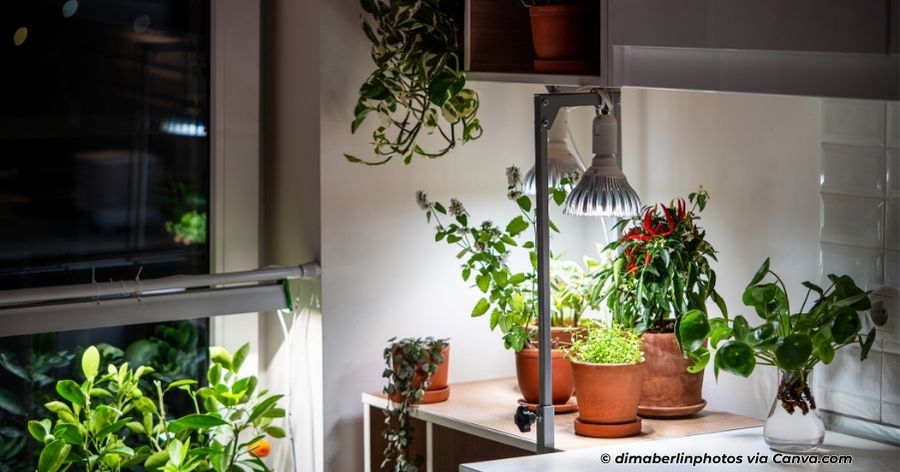
Your windowsills are full. Your plants keep growing. And that empty corner would be a perfect plant spot—if sunlight would kindly agree to go over there.
Grow lights can help you use spaces that don’t receive enough natural light. But choosing one gets confusing fast. Between wattage, light colors, timers, and product photos showing suspiciously enormous plants, it’s easy to wonder whether you’re buying a lamp or equipping a research facility.
For a small home, start with three questions: What plants are you growing? How much light do they already get? And where can you put a light without making the room harder to live in?
1. Start With the Plants, Not the Lamp
A pothos and a sun-loving cactus don’t have the same lighting needs. Before shopping, check the requirements of the plants you want to illuminate.
Also consider what the light needs to do:
- Supplement a window that gets weak winter light.
- Reach plants on a shelf below the windowsill.
- Support plants in a spot with very little daylight.
Those are different jobs. A small supplemental light that helps one plant near a window may be inadequate as the only light source for a whole shelf.
And remember: “low light” doesn’t mean “no light.” Even a forgiving houseplant needs enough light to support growth. Its reputation for surviving neglect is not a renewable energy source.
2. Choose a Shape That Fits Your Space
The best light for your room is partly a matter of where you can mount it and which leaves it can reach.
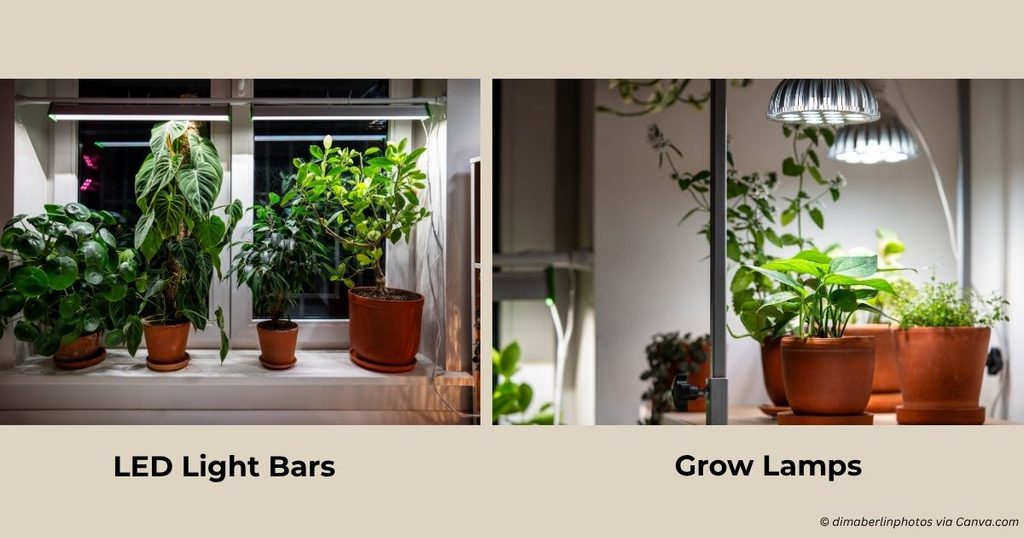
LED bars or strips: Worth considering for shelves. You can mount them beneath the shelf above, provided there’s suitable clearance and a secure mounting method. Compare the fixture’s length with the area occupied by your plants.
Grow bulbs in lamps: Useful when you want a light that blends into your furniture. Check the bulb’s socket, fixture, ventilation, and operating requirements before buying. A shade that directs light toward the plants can be more useful than one that sends most of it elsewhere.
Clip-on lights: An option for a desk or a small group of plants. Check whether the clamp fits the surface and whether the arm can hold its position.
Freestanding lights: May suit taller plants, but their bases still need floor space. Include that footprint when measuring your arrangement.
Choose the mounting location before ordering. Discovering that your new light has nowhere to attach is an annoying way to begin a gardening project.
Need somewhere to put your plants and lights? These vertical plant stand ideas can help you make better use of a small space.
3. You Don’t Have to Turn the Room Purple
Some grow lights produce a pink or purple glow. Others produce white light that looks more like ordinary room lighting.
White or balanced-spectrum lights can support plant growth, so a purple glow isn’t a requirement. For a living room or bedroom, white light may also be easier to live with.
However, “full spectrum” on the box doesn’t tell you whether the light delivers enough illumination to your plants. Color is only part of the picture.
Look beyond the product’s appearance and check its output, recommended distance, and coverage information.
4. Look Beyond the Wattage
Watts tell you how much electrical power a light uses. They don’t directly tell you how much useful light reaches a leaf.
Lumens describe brightness as perceived by human eyes. They can provide some information, but they aren’t a complete measure of a light’s usefulness for plants.
You may also encounter PPFD, a measurement of plant-usable light arriving at a surface.
You don’t need to memorize the abbreviation. The practical question is whether the seller provides meaningful measurements at a stated distance and across the area you need to illuminate.
One impressive number directly beneath the center of a lamp doesn’t describe the whole shelf. Check whether the plants around the edges will receive suitable light, too.
5. Placement Matters as Much as the Purchase
A light can be suitable for plants and still do very little from the wrong position.
As the distance from a fixture increases, the amount of light reaching the plant generally decreases. But there isn’t one correct distance for every grow light. Output, beam shape, plant requirements, and existing daylight all matter.
Start with the manufacturer’s recommended distance for your intended use. Look for guidance that applies to foliage houseplants rather than assuming instructions for seedlings fit everything.
Measure from the light to the foliage—not to the floor or the bottom of the pot.
On shelves, check for shadows from upper tiers and neighboring leaves. A lamp illuminating the top of your biggest plant may leave several smaller ones underneath in the dark.
Allow room to adjust the fixture as plants grow.
6. Put the Schedule on a Timer
A timer saves you from having to remember one more daily task. You already have enough things in your house expecting regular attention.
University of Minnesota Extension suggests around 12–14 total hours of light daily for foliage houseplants as a general guide. That includes available daylight; it doesn’t automatically mean adding another 14 hours of artificial light.
A plant beside a useful window may need less supplemental lighting than one relying mainly on a lamp. The strength of the light matters alongside the number of hours.
Set a consistent daytime schedule with an overnight period when the grow light is off. Check species-specific guidance for flowering plants, since day length can affect flowering.
More hours won’t fix every lighting problem. If the light is too weak or badly positioned, leaving it on longer may still fall short.
7. Choose a Setup You’ll Want to Keep Using
Before buying, picture the light operating in your actual room.
Will it shine into your eyes from the couch? Can you reach the plants to water them? Does the cable reach an outlet without crossing a walkway?
Check these details:
- Mounting: A secure fit for your shelf, desk, or stand.
- Coverage: Enough useful light across the intended plant area.
- Adjustment: Room to change height or direction.
- Controls: A timer that suits your schedule and resumes as expected after a power interruption.
- Comfort: A light color and position you can live with.
- Care access: Space to water plants without wetting electrical equipment.
Follow the fixture’s installation instructions and keep connections away from watering and runoff.
Start with one plant area rather than trying to illuminate the entire collection at once. Watch new growth over the following weeks and adjust thoughtfully. Stretching or pale growth can suggest insufficient light, but symptoms can have other causes, so check watering, roots, and pests as well.
The aim is enough suitable light in a practical spot—not a living room so bright that your neighbors think you’ve opened a garden center.